
By Martin O’Meowey | The Canton Cat
PHILADELPHIA — In a humiliating blow to modern government, 39 men signed the United States Constitution on September 17, 1787, after somehow creating an entire federal government in four pages without hiring a consultant.
Experts remain baffled.
There were no diversity consultants.
No communications team.
No stakeholder listening sessions.
No $14 million website explaining the meeting.
Nobody hired Deloitte to determine whether George Washington should sit at the front.
They just argued for months, wrote down how the government was supposed to work, and signed it.
Savages.
The delegates had gathered in Philadelphia largely because the existing national government under the Articles of Confederation wasn’t working very well.
Their solution was to create a stronger federal government while simultaneously spending enormous amounts of time worrying that the stronger federal government might become too strong.
Future Washington bureaucrats would later study this concern carefully before laughing until lunch.
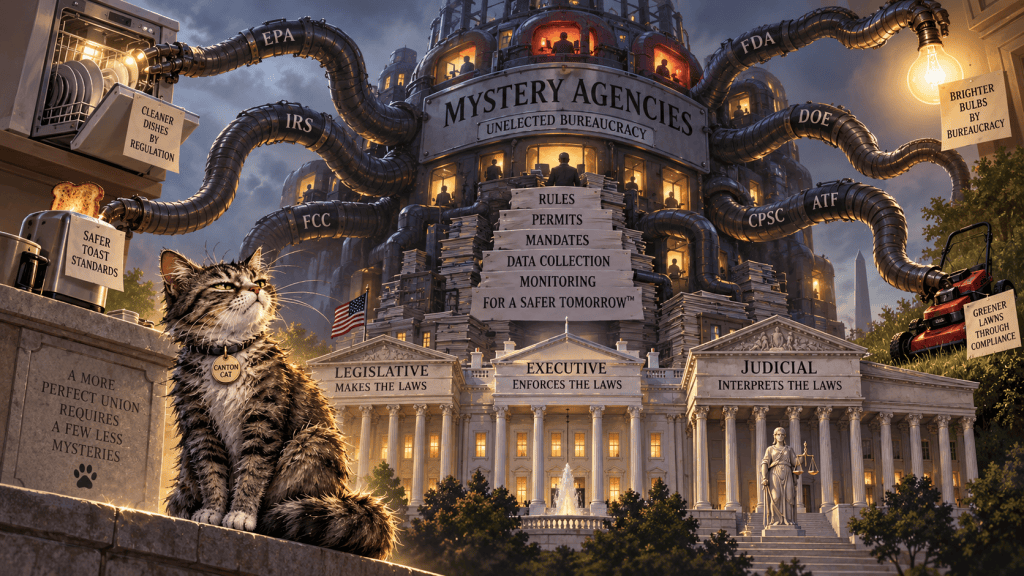
The Constitution divided federal power among three branches.
Congress would make laws.
The president would execute them.
Courts would interpret them.
At no point did anyone propose a fourth branch called:
“Unelected People Who Issue 900 Pages of Regulations About Your Dishwasher.”
James Madison helped design a system of checks and balances because the Founders understood something revolutionary:
Politicians cannot be trusted.
Modern politicians honor this wisdom every single day by proving them correct.
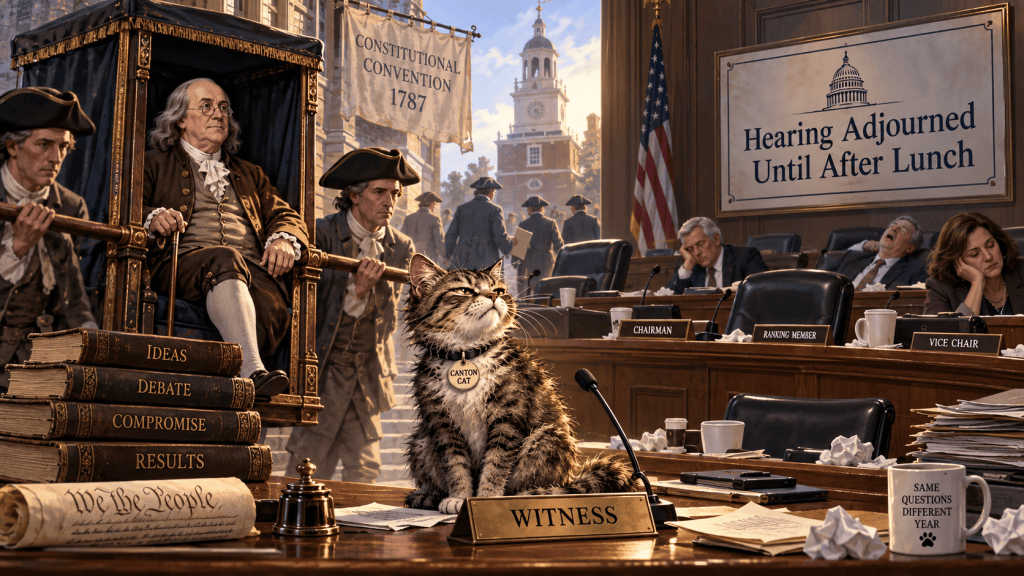
Benjamin Franklin attended the Convention at age 81 and was physically carried to some sessions in a sedan chair.
He still managed to contribute more to American government than approximately 70 percent of congressional committee hearings.
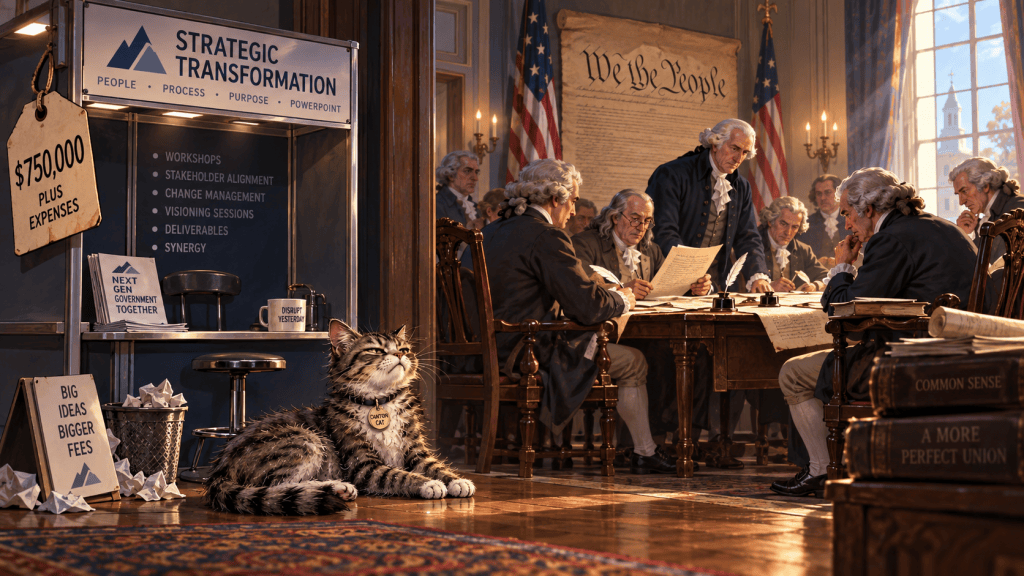
George Washington presided.
James Madison took extensive notes.
Alexander Hamilton argued for stronger national power.
George Mason, Elbridge Gerry, and Edmund Randolph refused to sign, in part because the Constitution lacked a bill of rights.
Notice what happened next.
They disagreed.
They argued.
They refused to sign.
And somehow nobody called the FBI because George Mason had concerns about government power.
Eventually Americans demanded explicit protections for individual liberties, leading to the Bill of Rights.
Those amendments included freedom of speech, freedom of religion, the right to keep and bear arms, protections against unreasonable searches, due process, and limits on government power.
Washington has spent the following 235 years asking:
“Okay, but how limited?”
The Framers also created a difficult amendment process so politicians couldn’t casually rewrite the nation’s governing document every time somebody lost an argument.
This was before Americans invented the modern alternative:
Pretend the Constitution says whatever your side needs before lunch.
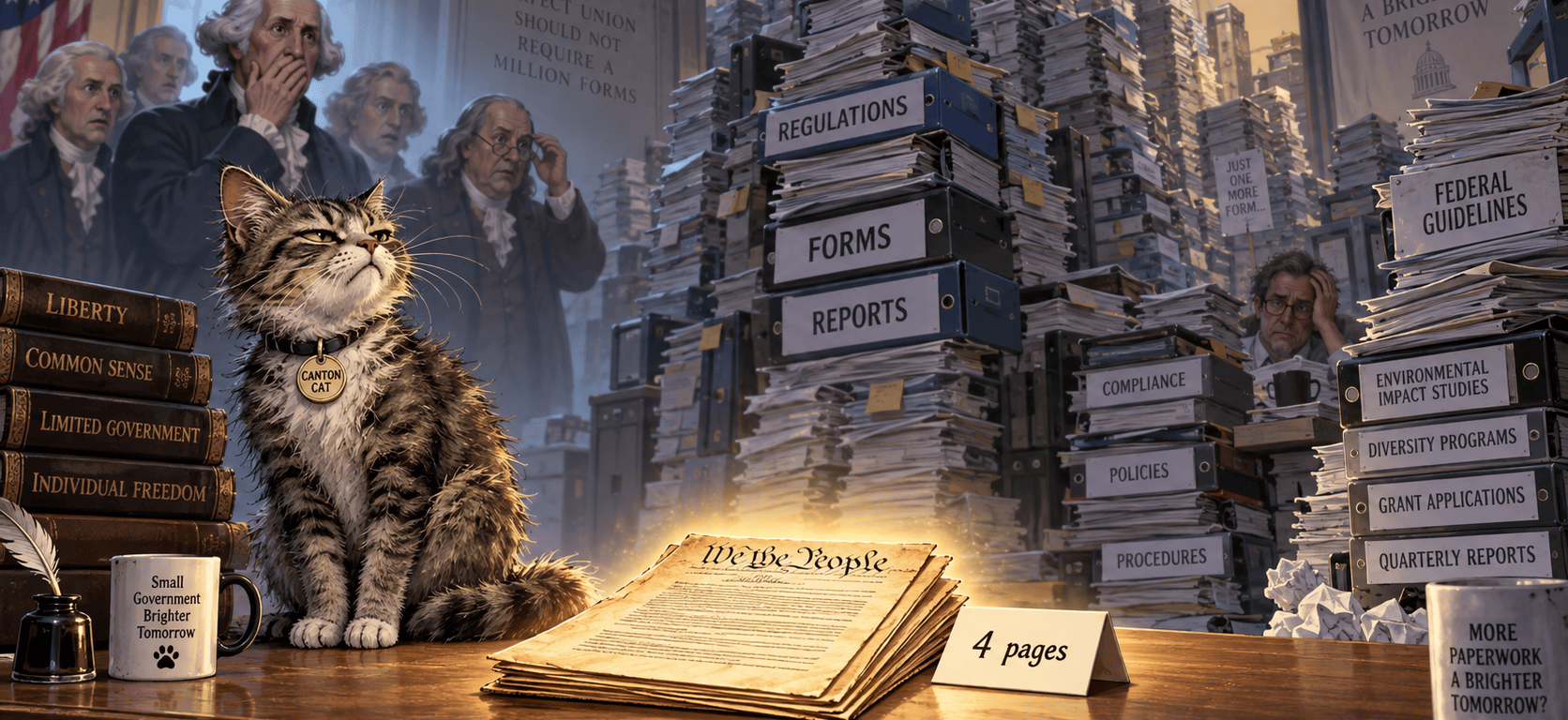
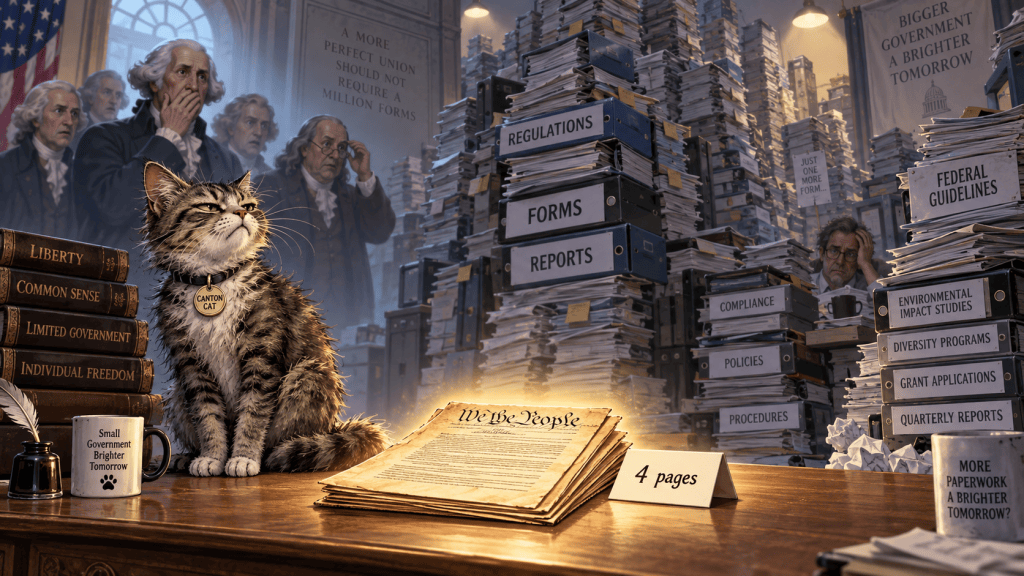
Perhaps most offensive to present-day Washington was the size of the document itself.
Four pages.
An entire national framework.
Four.
Pages.
Today the federal government could spend four pages defining the word “page.”
A congressional bill establishing National Turnip Awareness Week would require 600 pages, $800 million, seventeen grants, a pilot program in Guam, and a provision nobody noticed giving tax credits to electric forklifts.
The Constitution begins:
“We the People.”
Not:
“We the Agencies.”
Not:
“We the Lobbyists.”
Not:
“We the Emergency Continuing Resolution Passed at 2:13 A.M.”
And definitely not:
“We the consultants from McKinsey who prepared this 187-slide deck.”
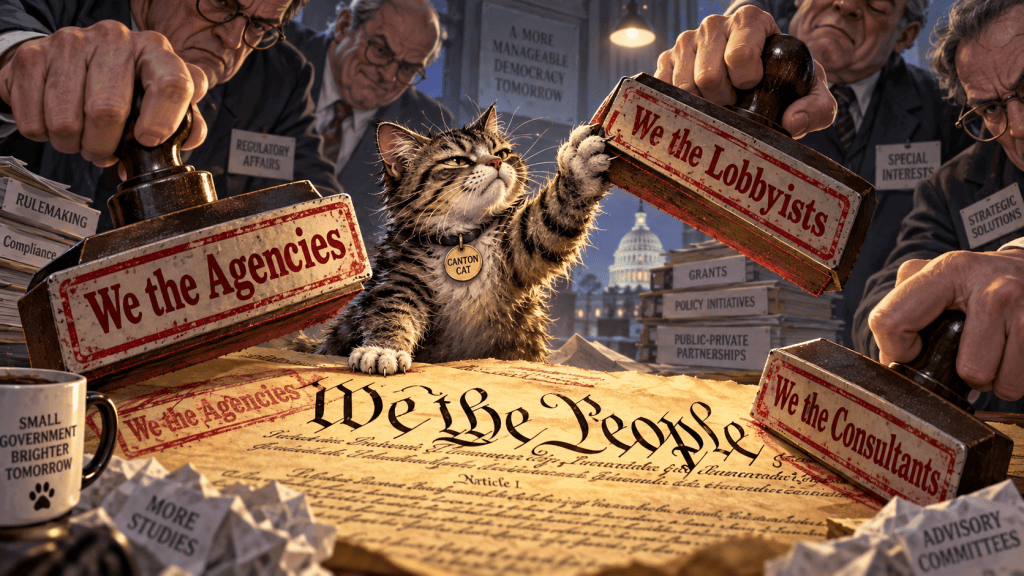
The Framers built a federal government designed around enumerated powers, divided authority, and institutional restraints because they were deeply concerned about concentrated government power.
America eventually responded by building a federal bureaucracy large enough that nobody is entirely sure who regulates toaster wattage, but somebody definitely does.
Still, on September 17, Americans celebrate Constitution Day.
A day honoring the remarkable document that created the American system of government.
Politicians celebrate by quoting whichever amendment currently helps them.
Bureaucrats celebrate by finding the footnote.
Lawyers celebrate by arguing over a comma written in 1787.
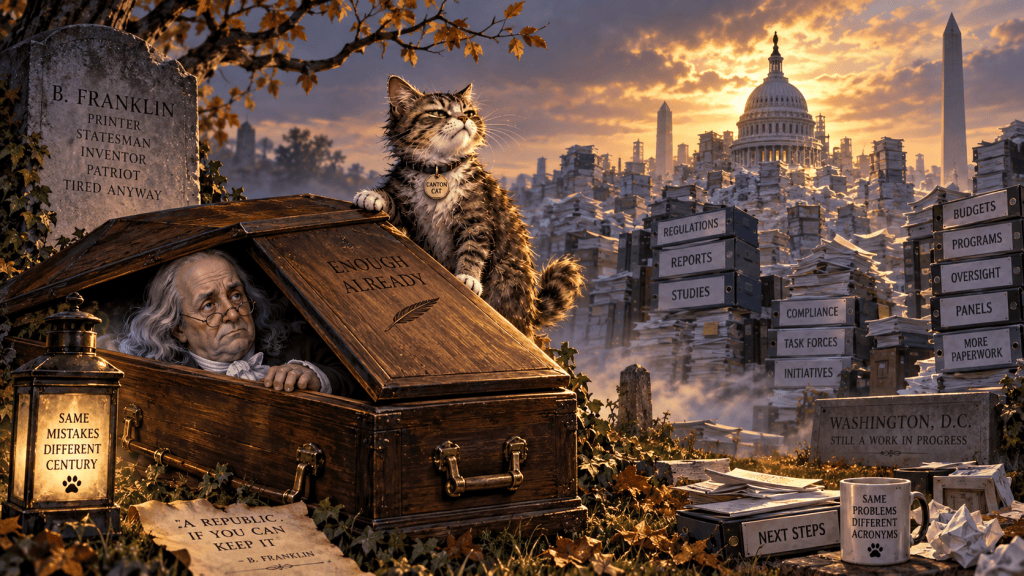
And somewhere, the ghosts of the Founding Fathers stare down at Washington, D.C., watching a $7 trillion federal government operate under their four-page document.
Franklin slowly closes the lid of his coffin.
 The Canton Cat