
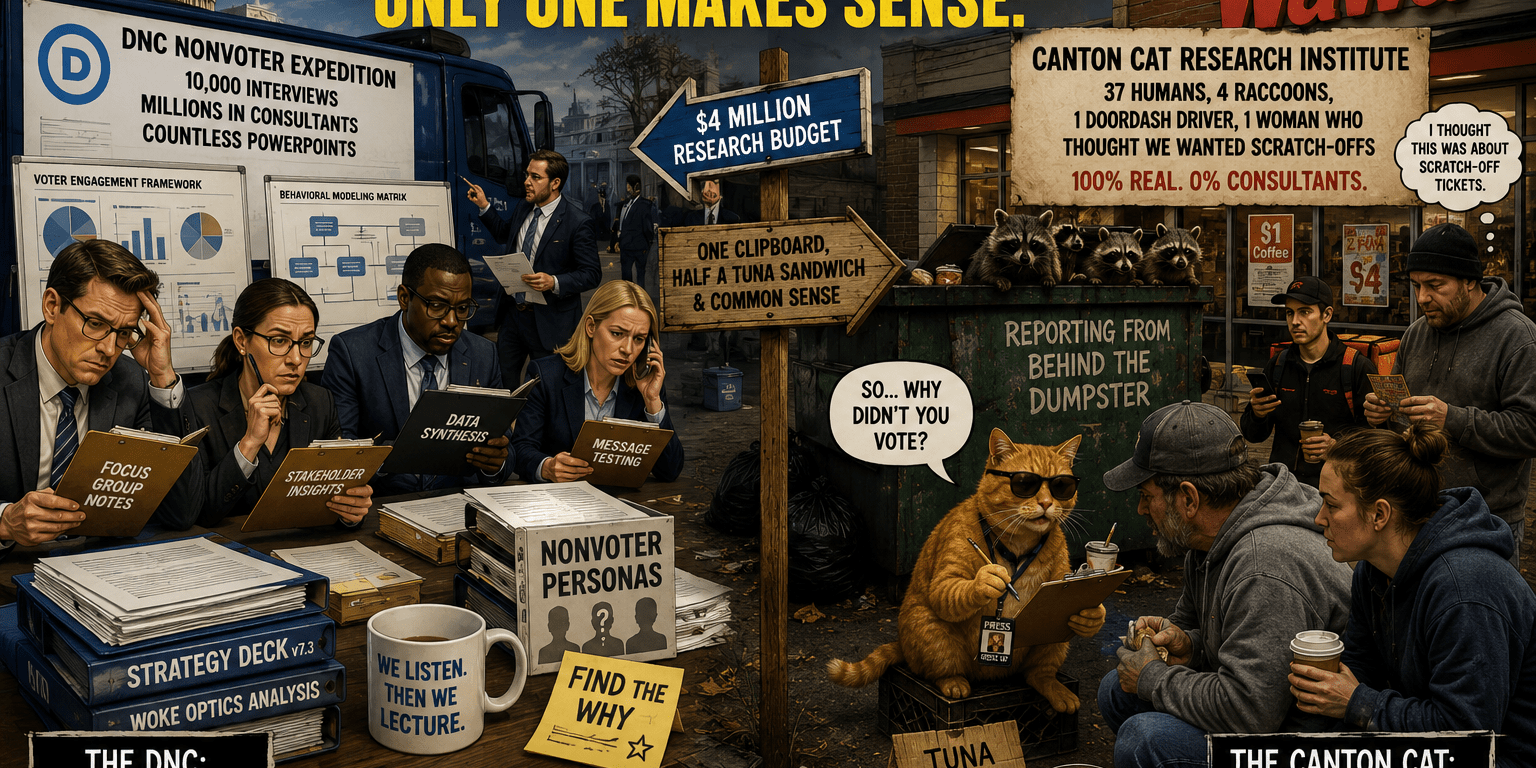
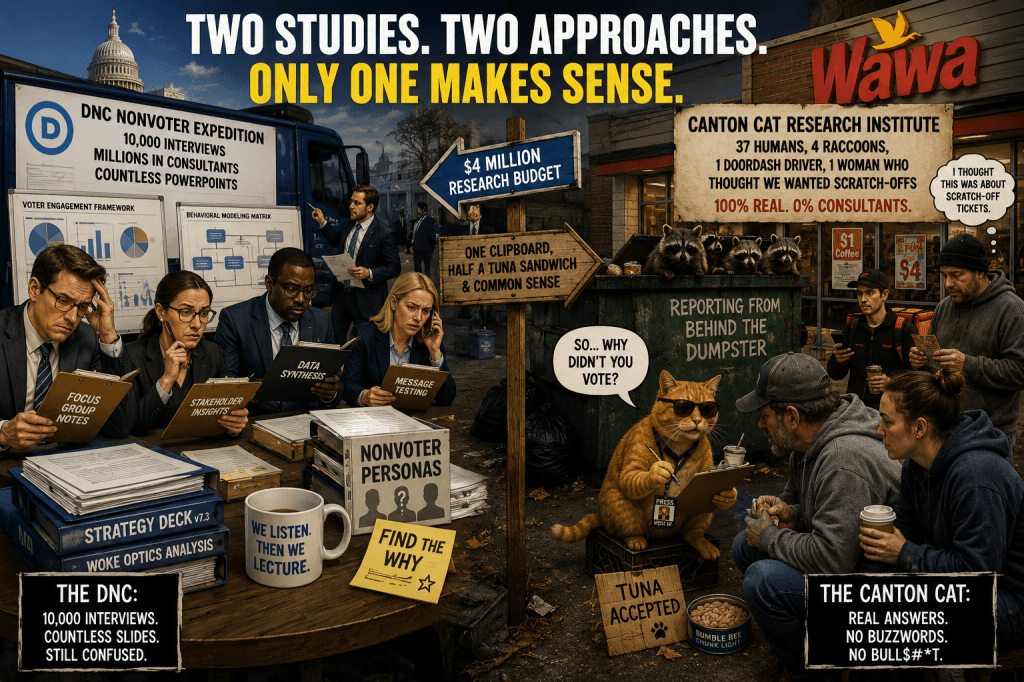
WASHINGTON — The Democratic National Committee has announced a groundbreaking political discovery after speaking with nearly 10,000 people who voted in 2020 but stayed home in 2024:
Apparently, voters have opinions.
Huge if true.
DNC Chair Ken Martin touted the party’s Local Listeners program, which sent organizers into communities to ask former voters why they vanished from the electorate.
The DNC says what it found could “change the game” for the 2026 midterms.
Naturally, The Canton Cat conducted its own competing study.
We had fewer resources.
No consultants.
No national field operation.
No Substack strategy memo.
Just one clipboard, a half-eaten tuna sandwich, and access to the alley behind a Wawa.
Yet somehow our findings were considerably easier to understand.
The Canton Cat Institute Interviewed America
Our nationally unrecognized research division surveyed 37 politically exhausted humans, four raccoons, one guy waiting for his DoorDash order, and a woman who thought we were asking about scratch-off tickets.
The findings were devastating.
Why did voters stay home?
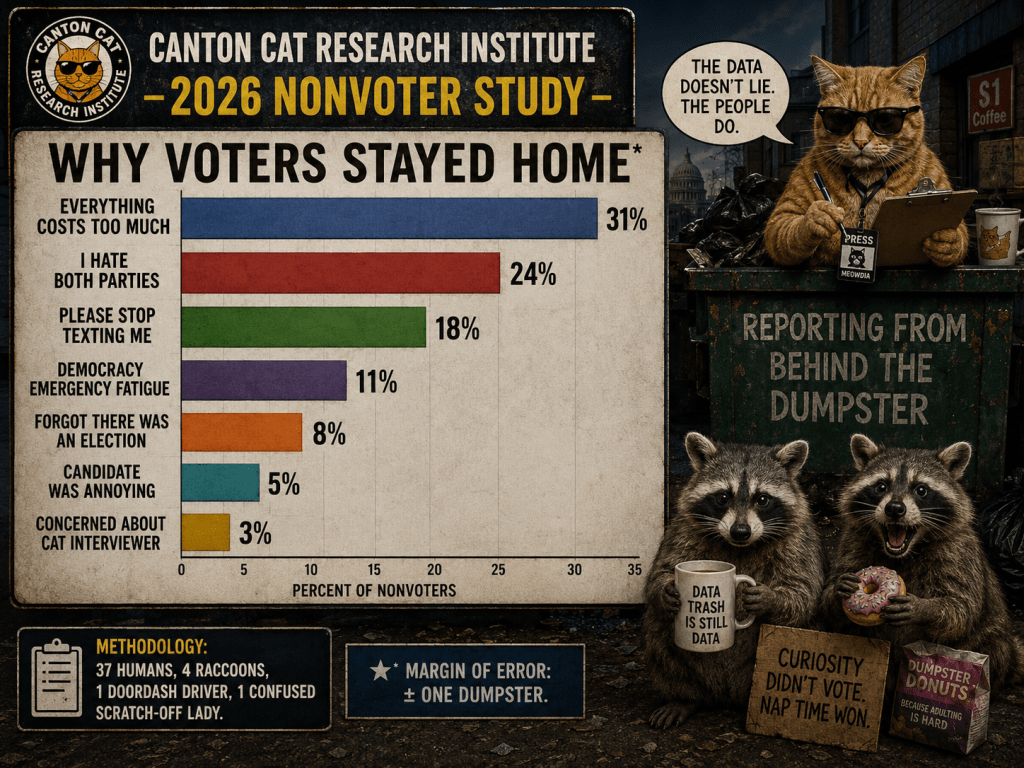
31% — “Everything costs too damn much.”
24% — “I hate both parties.”
18% — “Please stop texting me.”
11% — “I was told democracy would end approximately 400 times and eventually stopped listening.”
8% — “I forgot there was an election.”
5% — “Your candidate was annoying.”
3% — “Who are you and why is that cat holding a clipboard?”
Margin of error:
± one dumpster.
Democrats Discover the Revolutionary Concept of Listening
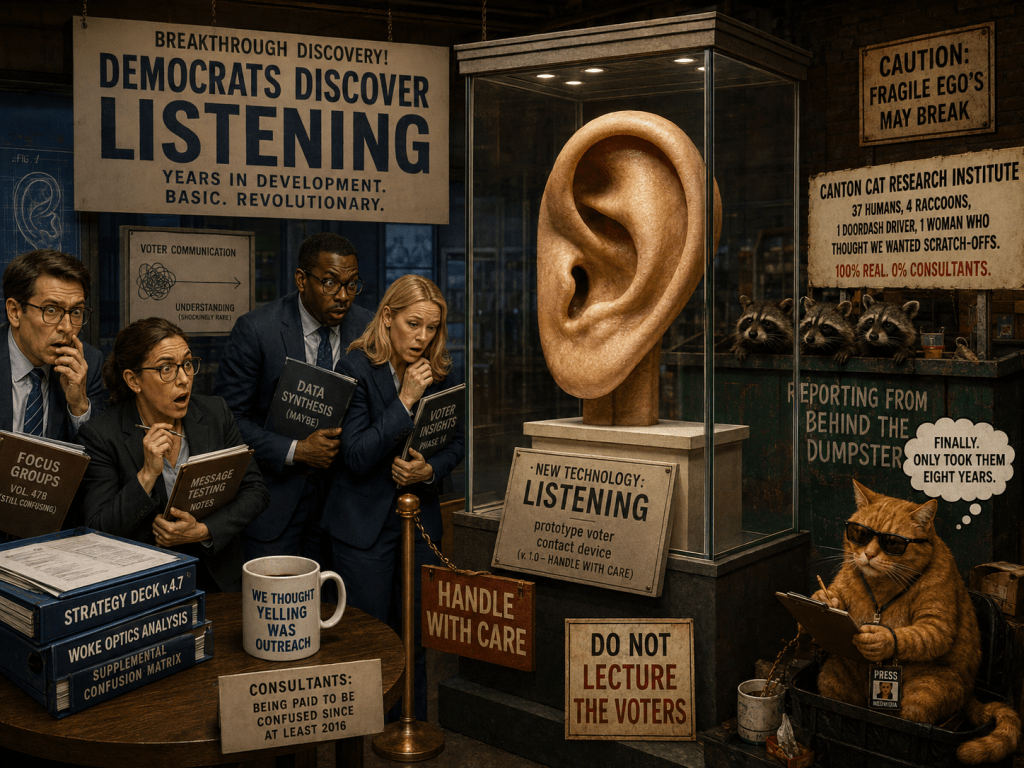
The DNC describes Local Listeners as a “listening-first” program.
Which raises a fairly obvious question:
What were you doing before?
Talking first?
Tweeting first?
Fundraising first?
Calling everyone fascists first?
Apparently the Democratic Party has spent years conducting political outreach with the same strategy my species uses to obtain tuna:
Stand outside.
Make noise.
Demand compliance.
Act offended when ignored.
Now they’ve discovered listening.
Congratulations.
Cats figured this out around 8,000 B.C.
We Also Asked Voters What They Want Democrats to Stop Talking About
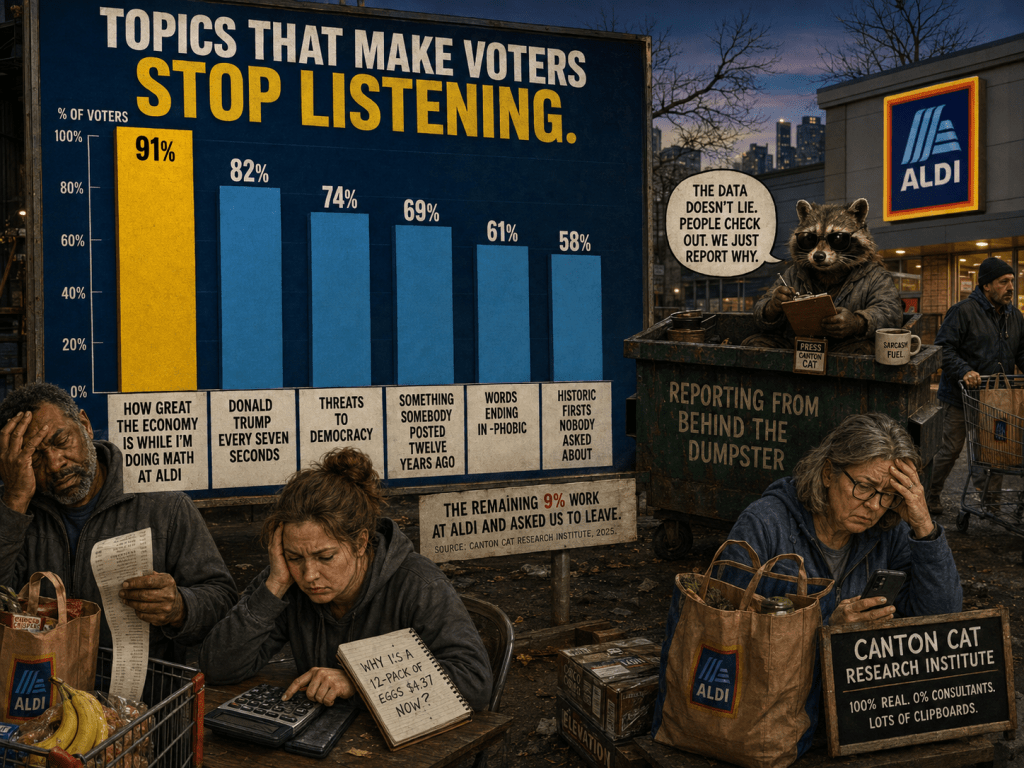
Our respondents were allowed multiple answers because The Canton Cat believes in scientific rigor whenever it helps the joke.
Results:
“Donald Trump every seven seconds” — 82%
“Threats to democracy” — 74%
“Something somebody posted twelve years ago” — 69%
“Words ending in -phobic” — 61%
“Historic firsts nobody asked about” — 58%
“How great the economy is while I’m standing in Aldi doing math” — 91%
The remaining 9% were employees at Aldi and asked us to leave.
Then We Asked What Might Actually Win Them Back
This is where the study became dangerous.
Because voters began mentioning things generally unavailable on cable news panels.
Lower prices.
Affordable housing.
Safer neighborhoods.
Better schools.
Lower taxes.
Less political insanity.
One respondent even suggested:
“Maybe nominate normal people.”
Our research team immediately suspended the interview due to radicalism.
The Consultants Will Surely Fix This
The beauty of modern politics is that any problem can be solved by hiring another consultant to explain why the previous consultants failed.
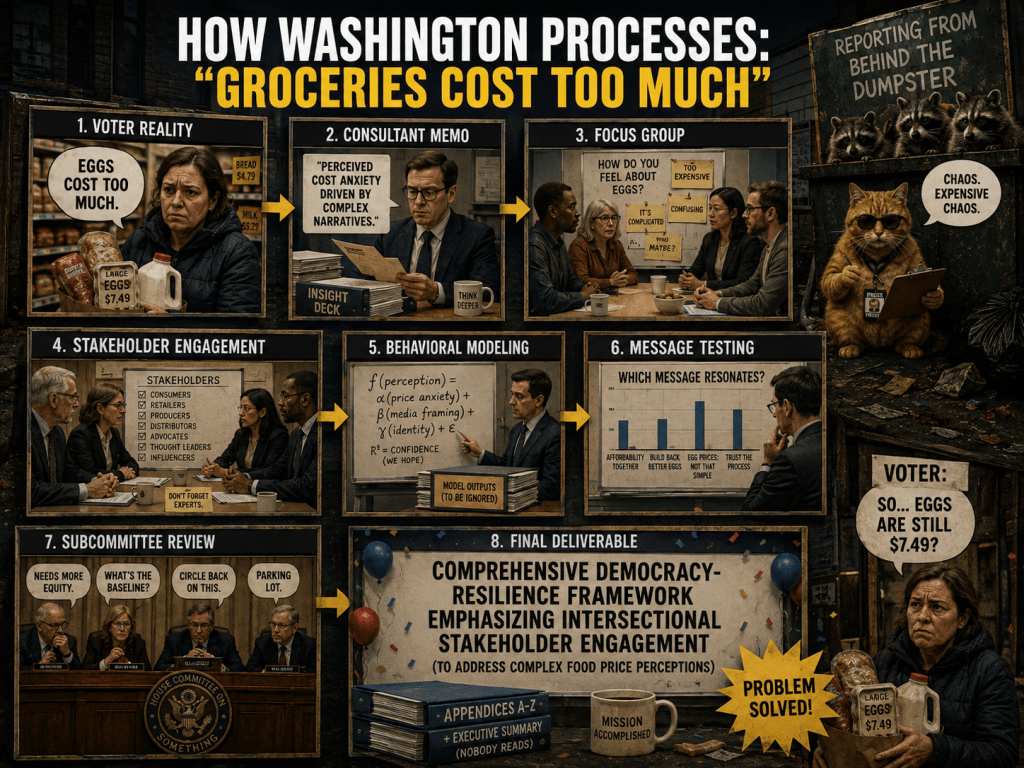
The DNC interviews 10,000 voters.
Those interviews become data.
The data becomes a report.
The report becomes a presentation.
The presentation becomes a strategy summit.
The strategy summit produces seventeen new phrases.
Those phrases are tested by focus groups.
The focus groups determine voters dislike the phrases.
The phrases are used anyway.
Then everybody gathers after Election Night and asks:
“Why aren’t working-class voters responding to our message?”
Because your message has been through so many consultants it now sounds like a hostage note written by LinkedIn.
Canton Cat Data Finds One Particularly Troubling Trend
We asked respondents to identify the phrase most likely to make them immediately stop listening to a politician.
The winner:
“Let me be clear.”
Second place:
“This election is about the soul of America.”
Third:
“Folks.”
Fourth:
“As a parent…”
Fifth:
“I grew up in a middle-class family.”
One voter heard all five and spontaneously registered Libertarian.
The Great Nonvoter Mystery
Political professionals speak about nonvoters like zoologists tracking an undiscovered rainforest species.
Where did they go?
What motivates them?
How do we reach them?
They’re not hiding.
They’re at work.
They’re paying rent.
They’re buying groceries.
They’re sitting in traffic.
They’re watching politicians discuss issues that somehow have nothing to do with the things making their lives miserable.
You don’t need a $4 million behavioral research initiative.
Try standing outside a gas station for twenty minutes.
Someone will explain America to you.
Probably loudly.
Democrats May Have Accidentally Learned Something Useful
Buried beneath the grand branding, the DNC’s instinct here isn’t crazy.
Talking to people who stopped voting is smart.
Listening instead of lecturing is even smarter.
The dangerous part comes afterward.
Because politicians have an extraordinary ability to hear:
“My groceries are too expensive.”
and translate it into:
“This voter desires a comprehensive democracy-resilience framework emphasizing intersectional stakeholder engagement.”
No.
She wants eggs to cost less.
Write that down.
Canton Cat Asked One Final Question
We asked:
“What would make you more likely to vote in the midterms?”
The top response wasn’t Democratic.
It wasn’t Republican.
It wasn’t ideological.
It wasn’t complicated.
It was:
“Give me somebody worth voting for.”
There you go.
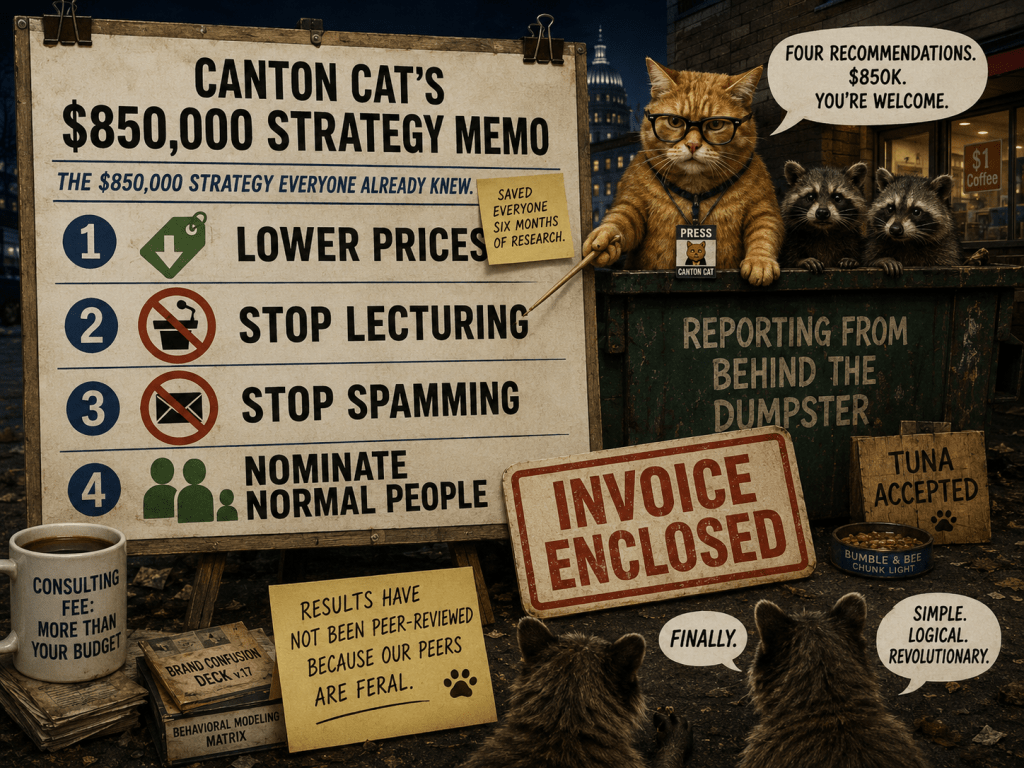
Saved everyone six months of research.
Invoice forthcoming.
Official Canton Cat Findings
After reviewing all available evidence, licking ourselves for approximately twenty minutes and throwing the methodology into a cardboard box, our institute has reached the following conclusions:
Voters notice prices.
Voters hate being talked down to.
Voters dislike political spam.
Voters are tired of permanent emergencies.
Voters would occasionally enjoy hearing what politicians plan to actually do.
And perhaps most importantly:
People who didn’t vote cannot be bullied into becoming enthusiastic about the people they deliberately didn’t vote for.
That’ll be $850,000, DNC.
Consulting rates.
Tuna accepted.
Reporting From Behind the Dumpster. 🐈
Canton Cat Research Institute — 2026 Nonvoter Study
| Finding | Totally Scientific Result |
|---|---|
| Everything costs too much | 31% |
| Hate both parties | 24% |
| Stop texting me | 18% |
| Democracy emergency fatigue | 11% |
| Forgot election existed | 8% |
| Candidate was annoying | 5% |
| Concerned about cat interviewer | 3% |
Methodology: 37 humans, four raccoons, one confused delivery driver. Results have not been peer-reviewed because our peers are feral.

