
By Martin O’Meowey | The Canton Cat
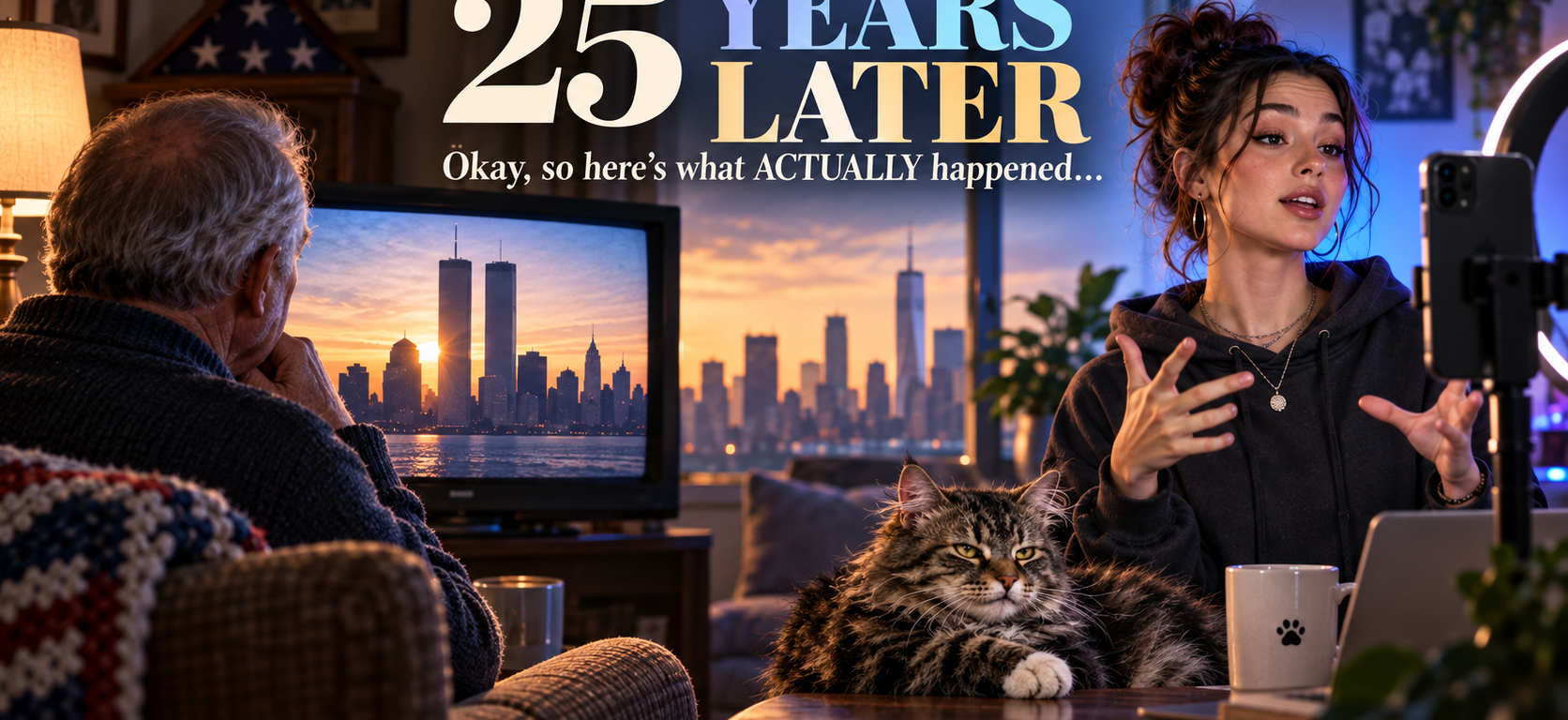
WASHINGTON — Twenty-five years after the September 11 attacks, a generation that was not alive for them has reportedly reached the age where it can confidently explain the entire event to people who watched it happen live.
The lessons are being delivered primarily through TikTok videos beginning with:
“Okay, so here’s what ACTUALLY happened…”
Americans who remember exactly where they were that morning have been informed that their firsthand memories are “problematic,” “missing context,” and “kind of giving Cold War energy.”
“I was standing in my office watching the second plane hit,” said one 54-year-old man before being interrupted by a 23-year-old holding an iced coffee.
“Right, but did you watch the 11-part explainer?”
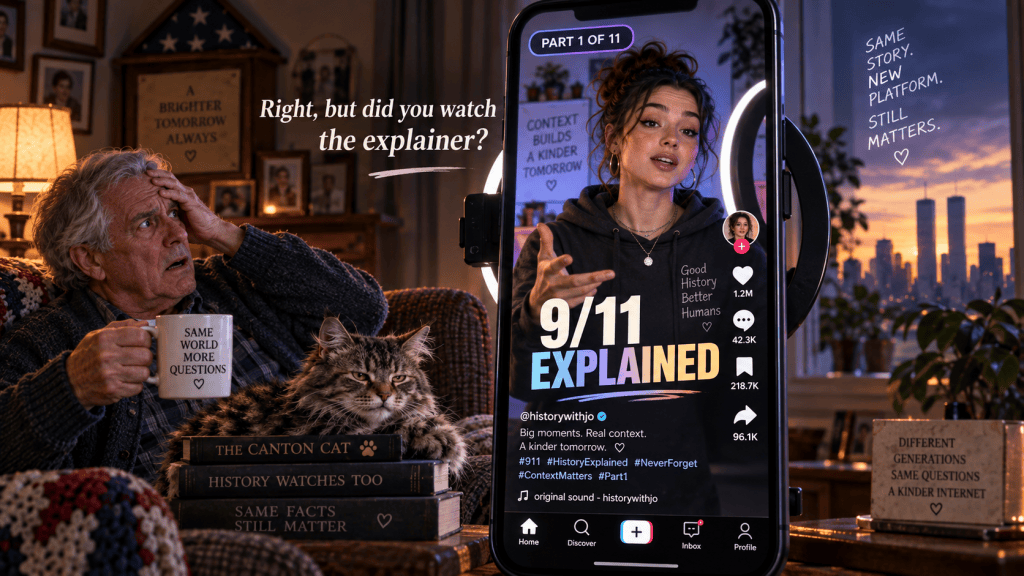
Experts say this marks an important milestone in American history: the moment when people born after an event become more certain about it than the people who survived it.
Historians once believed this process required decades.
TikTok has apparently cut the turnaround time to about 25 years and a ring light.
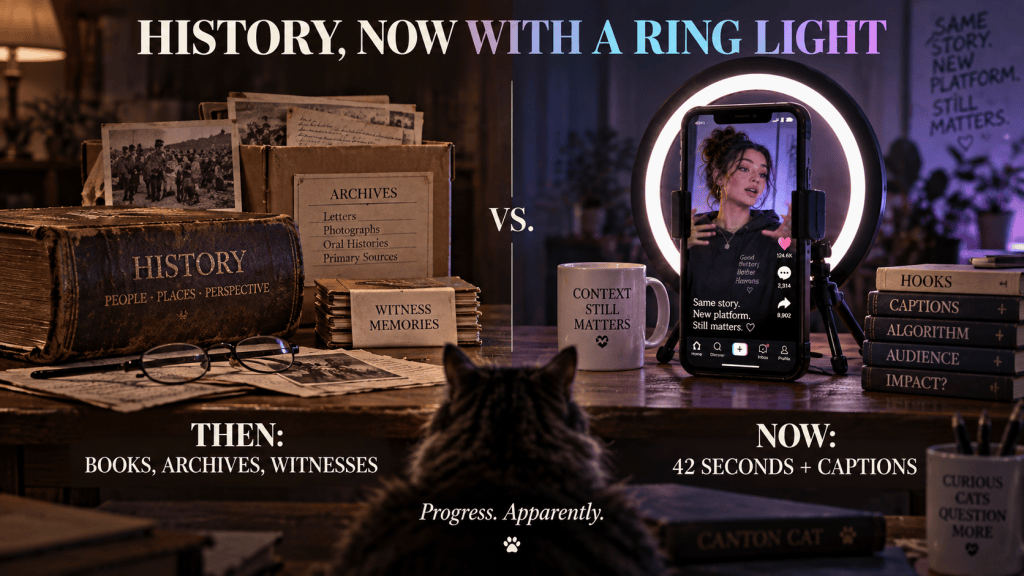
The new generation of 9/11 scholars has reportedly uncovered several groundbreaking discoveries, including that George W. Bush was president, airports used to be less miserable, and Americans briefly put flags on everything that did not move.
One viral video titled “9/11 EXPLAINED FOR MILLENNIALS” was reportedly viewed 8 million times before commenters pointed out that millennials remember 9/11.
The creator responded:
“Wow, I didn’t know that.”
Another influencer explained the post-9/11 era while applying skincare.
“So basically,” she said, “America entered this whole war-on-terror phase, which was honestly super toxic.”
A retired firefighter watching the clip reportedly stared silently at his phone for several seconds before placing it facedown on the table and going outside.
The Canton Cat understands the feeling.
I once watched a kitten explain dumpsters to me.
He had never been inside one.
The algorithm remembers differently
For Americans old enough to remember September 11, the anniversary tends to arrive through memories.
A classroom television.
A radio broadcast.
Smoke over Manhattan.
A phone call.
Someone who never came home.
For younger Americans, it arrives through archives.
Clips.
Documentaries.
Wikipedia.
Podcasts.
And, naturally, a 42-second vertical video with dramatic background music and captions flying across the screen.
None of that is inherently bad.
Every generation has to learn history somehow.
The problem begins when learning about history gets confused with personally discovering it.
This is how America now gets videos titled:
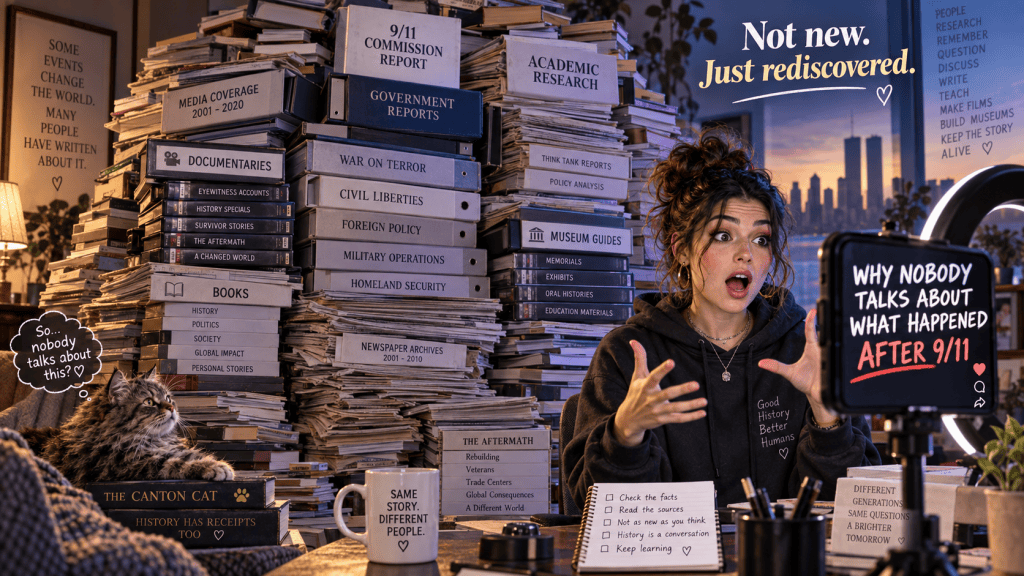
“Why Nobody Talks About What Happened After 9/11.”
There have been approximately 600 books, 14 million news articles, congressional investigations, government reports, documentaries, memorials, museum exhibits, university courses, and 25 consecutive years of national arguments about what happened after 9/11.
But sure.
Nobody talked about it until Brayden found a podcast.
Soon they will explain Blockbuster too
Demographers warn the trend is unlikely to stop.
The same generation will soon begin informing older Americans that people once rented movies from physical stores.
A 22-year-old will eventually upload:
“Did you know Netflix used to come IN THE MAIL???”
Millions will gasp.
Someone who still owes Blockbuster $17.43 will quietly close the app.
By 2035, historians expect teenagers to discover Facebook and explain to millennials that it was originally designed for college students.
By 2040, a teenager will post:
“People in the early 2000s apparently had to PRINT directions from a website called MapQuest.”
Every person over 45 will instantly turn to dust.
But this anniversary is different
There is, however, something important underneath the generational comedy.
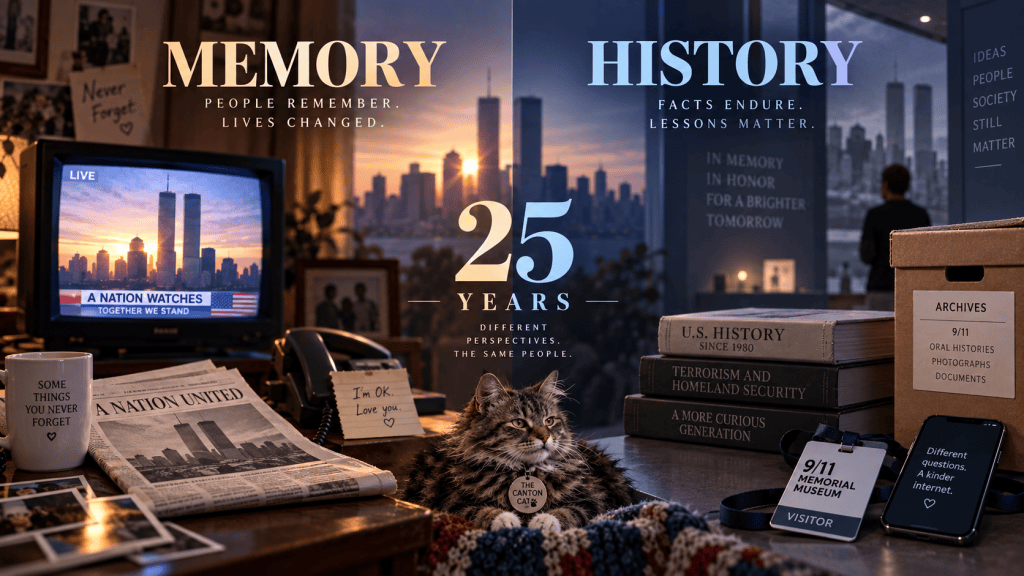
Twenty-five years is long enough for September 11 to begin changing categories.
For millions of Americans, it is memory.
For millions more, it is history.
That transition was always coming.
Children sitting in classrooms today were born more than a decade after the towers fell.
They cannot remember something they never experienced.
So they will inherit it from everyone else.
From families.
From teachers.
From museums.
From survivors.
From old footage.
And, yes, probably from TikTok.
The responsibility belongs to the rest of us to make sure what gets passed down is more than a collection of clips detached from the people inside them.
Because September 11 was not content.
It was a morning.
Nearly 3,000 people went to work, boarded airplanes, reported for duty, or simply started an ordinary Tuesday and never came home.
Thousands more spent years living with what followed.
That is harder to fit into 42 seconds.
History eventually belongs to people who weren’t there
This happens to every national tragedy.
Pearl Harbor became something most Americans knew from parents and grandparents.
Then books.
Then movies.
Then classrooms.
Eventually there were very few people left who could say:
I remember.
September 11 is now moving down the same road.
The generation explaining it online may occasionally be insufferable about it.
Fine.
Young humans are supposed to believe they invented knowledge.
It gives them something to do before their knees start hurting.
But someday, they will be the ones explaining September 11 to children who were born 50 years after it happened.
And when that day comes, the important question will not be whether they learned it from a textbook, documentary, museum, parent, podcast, or irritating man pointing at floating captions.
It will be whether they understood what happened.
Whether they know the names mattered.
Whether they understand why people still gather every September and read them aloud.
Whether the morning remains human instead of becoming just another historical date.
So yes, Gen Z.
You may explain 9/11 to us.
The Canton Cat merely asks one favor.
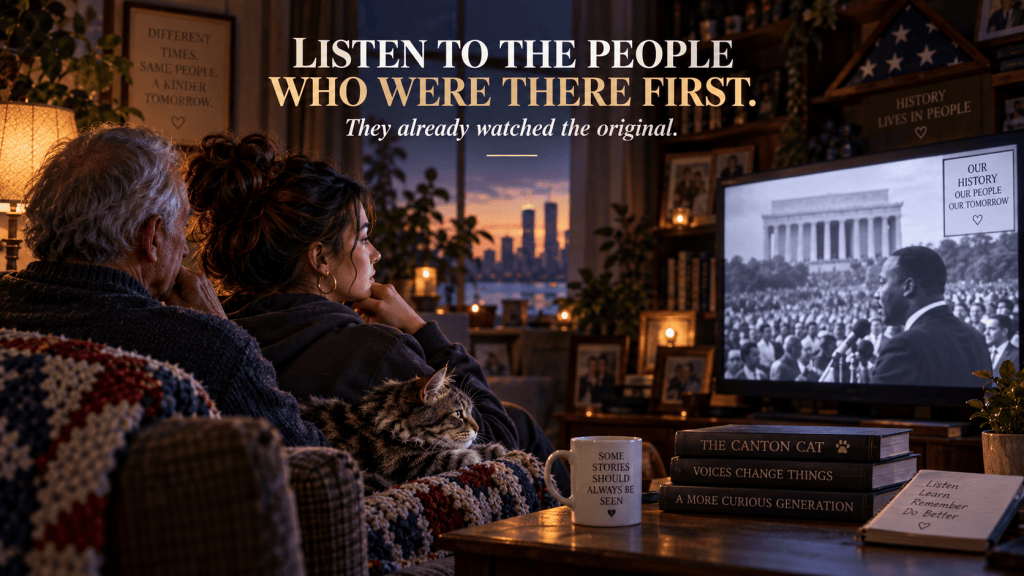
Maybe listen to the people who were there first.
They already watched the original.
And unlike TikTok, it did not have a part two.
 The Canton Cat