
By Martin O’Meowey | The Canton Cat
Charlie Kirk has been gone for a year, which has done surprisingly little to remove him from American politics.
One year ago today, his life ended. Since then, his absence has had a strange habit of behaving like a presence.
Somebody posts a new controversy. Somebody else digs through Kirk’s old feed. Five minutes later, there he is again — three years early, wearing a suit, pointing at somebody, already arguing about it.
It would be funny if it weren’t also a little haunting.
Every few days, an old clip starts circulating.
Kirk talking about college campuses.
Kirk talking about free speech.
Kirk talking about immigration.
Kirk talking about men, women, elections, media, religion, culture, or whatever fresh national emergency Americans have decided absolutely cannot wait until after lunch.
Then somebody posts it with some variation of:
“Charlie was talking about this years ago.”
And just like that, on the anniversary of his death, a man who is gone still manages to reappear in the timeline.
Again.
The Canton Cat has lived behind enough dumpsters to understand that humans are terrible at throwing anything away, but this is getting ridiculous.
The internet does not understand death
For most of human history, death meant absence.
A voice disappeared.
A face became a photograph.
A story survived because somebody remembered it.
That is not how it works anymore.
Now a person can die and leave behind thousands of hours of video, years of posts, podcasts, speeches, arguments, jokes, interviews, debates, photos, text messages, and badly lit livestreams from hotel rooms.
The strange thing about the internet is that people no longer disappear cleanly.
Their voices remain searchable.
Their arguments wait patiently in old videos.
Their jokes come back without them.
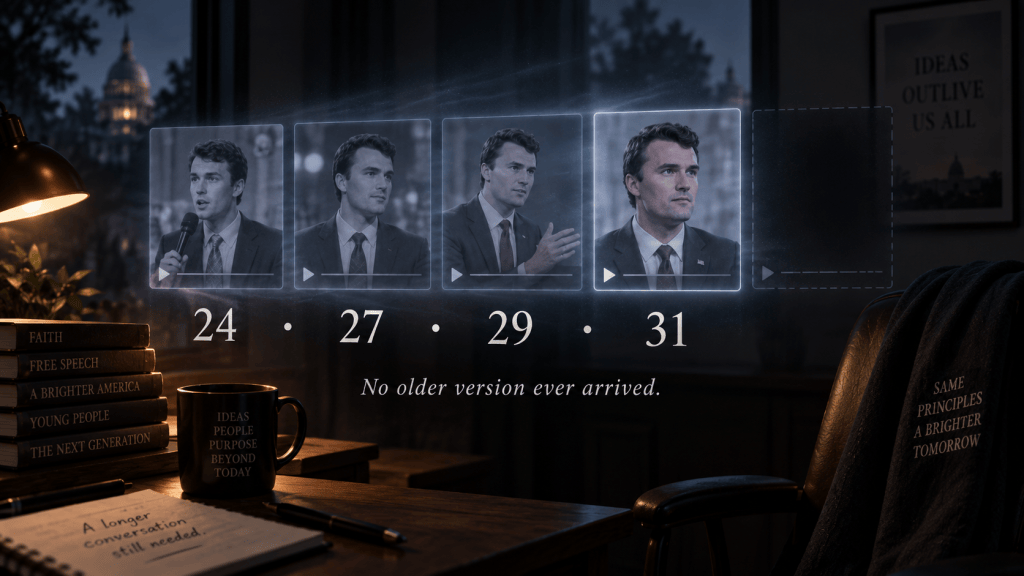
Kirk left behind an enormous digital record, which means America keeps encountering versions of him frozen at 24, 27, 29, 31 — still talking, still debating, still completely unaware that eventually there would be a last clip.
A last speech.
A last post.
A last time he walked off a stage expecting another one.
Everybody still wants an answer
There is something particularly strange about Kirk’s online afterlife because his entire public identity was built around answering people.
Put a microphone in front of him, and Charlie Kirk would generally have something to say.
Sometimes loudly.
Usually immediately.
Frequently while somebody across a folding table regretted volunteering for the question.
That became part of the appeal.
Supporters liked that he would walk directly into hostile rooms and argue.
Critics liked having somebody specific to argue against.
The whole machine depended on Charlie being there for the next round.
And now the next round keeps happening without him.
The controversies keep arriving.
The political fights keep changing.
The campus videos keep getting uploaded.
The internet keeps asking questions.
And Charlie Kirk is permanently stuck with the answers he already gave.
So people search.
They find an old clip.
They post it.
And for three minutes and forty-seven seconds, he is back.
Sometimes the clip fits a little too well
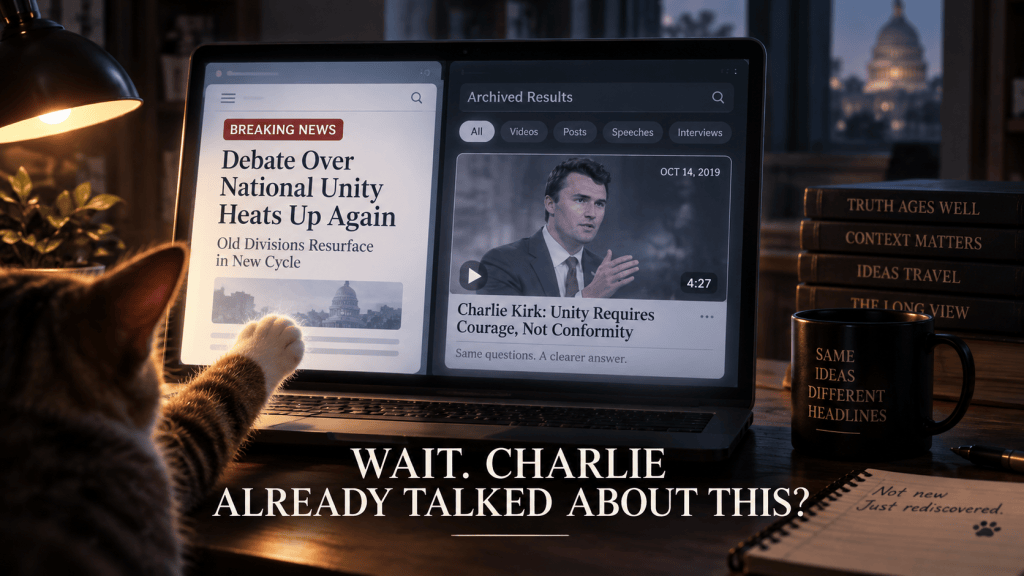
There is an almost comedic rhythm to it now.
A major story breaks.
Everyone screams for six hours.
Someone quietly enters the archive.
And suddenly Charlie Kirk appears on your screen from 2021, saying something suspiciously close to the argument everybody just discovered this morning.
You can practically hear the collective groan.
Oh, come on. He already talked about this too?
Apparently dying did not excuse the man from staying current.
But underneath the joke is something harder to explain.
Old footage feels different when you know the person in it has no idea how little time he has left.
You watch him talking about some issue that seemed enormously important that afternoon.
You watch him laugh.
You watch him interrupt somebody.
You watch him predict what happens next.
And you know something he doesn’t.
There will eventually be no next debate.
That knowledge changes the clip.
We usually don’t know when something becomes the last time
That may be the unsettling part.
People rarely recognize their final ordinary moments while they are living them.
Nobody says, “Well, this will be my last Tuesday.”
Nobody closes a laptop thinking, “There. Final tweet.”
Nobody leaves the house announcing, “That concludes my lifetime supply of car rides.”
Life almost never provides that kind of warning.
It just keeps being normal until suddenly it isn’t.
Kirk was 31.
Whatever you thought of his politics, 31 is an absurdly young age to become an archive.
There should have been decades of arguments left.
Positions he might have changed.
Arguments he might have sharpened.
Predictions he would have gotten right.
Predictions everyone would have gleefully reminded him he got wrong.
There should have been older versions of Charlie Kirk available to disagree with the younger ones.
Instead, there is a hard stop.
Everything afterward belongs to everybody else.
A legacy is a strange thing when the person is gone
The word legacy gets thrown around so casually that it can sound like something assembled by a public-relations department.
It isn’t.
A legacy is what remains after somebody loses control of the story.
Other people decide which clips matter.
Other people quote you.
Other people explain what you “would have thought.”
Other people carry pieces of you into arguments you never saw coming.
Some do it sincerely.
Some do it politically.
Some do it because an old clip gets engagement.
Welcome to humanity. The cat has complaints.
But the persistence of Kirk’s voice says something about the footprint he left.
People are still looking for what he said.
Supporters are still sharing it.
Critics are still responding to it.
Young people who never saw a particular speech when it happened are finding it years later.
An argument made into a microphone on some random afternoon now gets another audience the speaker never knew would exist.
That is a peculiar kind of permanence.
And then there is the part politics tends to flatten
Political figures eventually become symbols.
Supporters turn them into heroes.
Opponents turn them into villains.
The internet turns everybody into content.
But before any of that, Charlie Kirk was a human being whose life ended violently at 31.
A husband.
A father.
A son.
A friend.
There are people for whom this date is not an anniversary of a political event.
It is simply the day Charlie did not come home.
That reality deserves more space than American politics usually gives it.
Because once someone becomes famous enough, the public starts behaving as though it owns part of them.
Their words become ours.
Their images become ours.
Their arguments become ours.
Their death becomes something we debate.
But grief does not belong to the audience.
It belongs first to the people who knew the person after the cameras stopped.
He keeps showing up
There will probably be another Charlie Kirk clip circulating next week.
Maybe tomorrow.
Maybe before this flea-bitten cat finishes knocking somebody’s coffee off the table.
There will probably be another old tweet that suddenly looks like it was written yesterday.
Someone will post it.
Someone will celebrate it.
Someone will argue with it.
Someone will insist it proves everything.
And once again, Charlie Kirk will briefly reappear in American politics.
Everyone will argue about whether he was right.
That part will continue for years.
Maybe decades.
But there is one thing nobody gets to argue about.
He should have been here to answer for himself.
He should have been allowed to grow older than his archive.
He should have gotten more chances to be right, wrong, brilliant, annoying, funny, infuriating, persuasive, ridiculous, serious, and alive.
A year without Charlie Kirk has not removed him from the conversation.
Old videos.
Old posts.
Old arguments.
Old warnings.
But the one place he cannot show up is the place where he actually belongs:
in the present.
Even this stray cat knows that’s the part that matters.

 The Canton Cat